Privacy in the desktop wallet is a set of coins, not a single private pile the software spends for you. Coin control is the set of lists, freezes, labels, splits, and pickers that make those coins selectable. Peg-in, Privacy send, peg-out, and denomination splits all go through that selection. Without it, a Privacy balance is a black box.
Transparent coins and Privacy coins are chosen on different requests. A Transparent send, and the Transparent side of a peg-in, can take specific outpoints. A Privacy send and a peg-out can take specific Privacy output ids. Coins you freeze are skipped when the wallet would otherwise choose Privacy inputs automatically. A frozen coin stays where it is until you unlock it or pick it on purpose.
Each coin can carry a label. Those notes sit with the rest of the non-secret metadata: contacts, transaction labels, split transaction ids, and frozen Privacy ids. That bundle can be exported and imported, and import merges with what is already on disk. Labels are bookkeeping for you. They are not published on chain by the act of naming a coin.
Peg-in, from coins you already hold
A peg-in is a self-transfer from this wallet’s own Transparent outputs. An exchange, or anyone else, pays the normal ltc1 address. The wallet then offers to move those funds to Privacy. Transparent coin control covers that step for Send and for the Transparent-to-Privacy swap: the wallet can list unspent Transparent coins, freeze the ones you want left alone, and spend only the outpoints you opted in.
Peg-in maturity is six blocks. The wallet distinguishes coins that are already spendable from coins that are still maturing, and it includes unconfirmed Privacy coins in that picture. History can show a maturing pill on the peg-in so the wait is visible instead of looking like a missing balance.
Under the buttons, the library path is the same shape the wallet uses everywhere else for Privacy. The Transparent chain tip comes from Electrum or from litecoind RPC. Privacy coins live in a store synced over LIP-0006, not over Electrum. A peg-in is prepared, funded, signed, and extracted, then broadcast. Coin control decides which Transparent coins enter that prepare step. It does not change the peg-in into a different kind of transaction.
Splits
A split is a 1-in-N-out transfer back to the same wallet. It exists for both Transparent coins and Privacy coins. From the Coins list, the split dialog can divide a coin into equal parts or into preset denominations. Simple Send stays a payment to one recipient. A split is not that payment. It is how one output becomes several outputs you can later select on their own.
History records the Transparent form as a split and the Privacy form as a Privacy split. The split transaction id is part of the metadata bundle, so a later import can still recognize it. The wallet does not describe a split as a mixing step. It is a way to choose denominations before a later send, peg-in, or peg-out.
Peg-out, one Transparent output or one per coin
Peg-out has two shapes, and the difference is whether you picked coins.
A typed amount, with no coins chosen, stays a single HogEx output. Max, or an explicit set of Privacy coins, is N-to-N: one fresh ltc1 address for each Privacy coin, a single kernel, and the fee taken from the largest coin. History still shows one peg-out entry for that operation. You are not required to melt every selected coin into one Transparent output, and you are not required to peg out the entire Privacy balance to move one coin.
Privacy send uses the same kind of picker. You choose the Privacy output ids that should fund the payment. Anything frozen is left out of the automatic selection, so a coin set aside for a later peg-out or a self-spend is not quietly consumed by a different send.
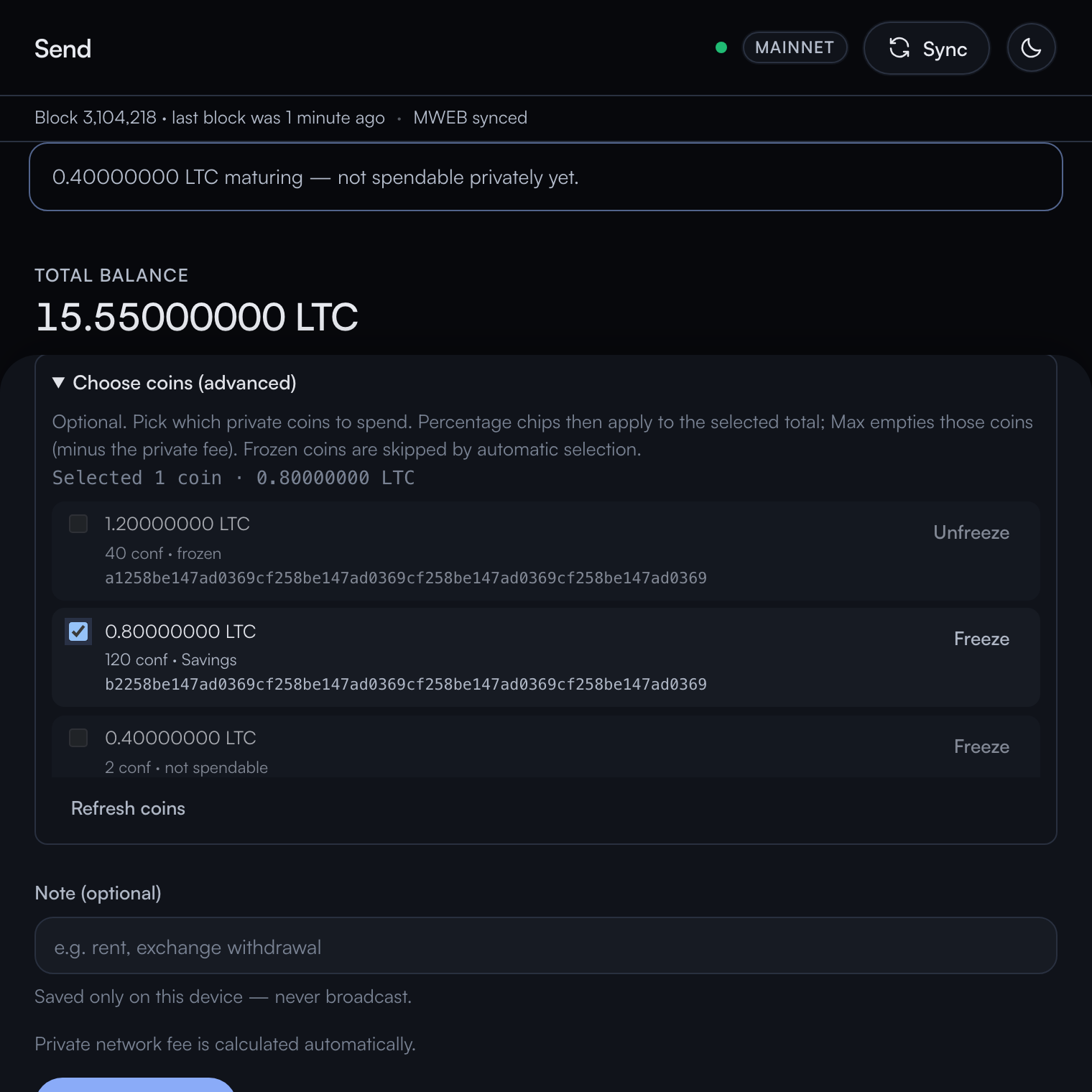
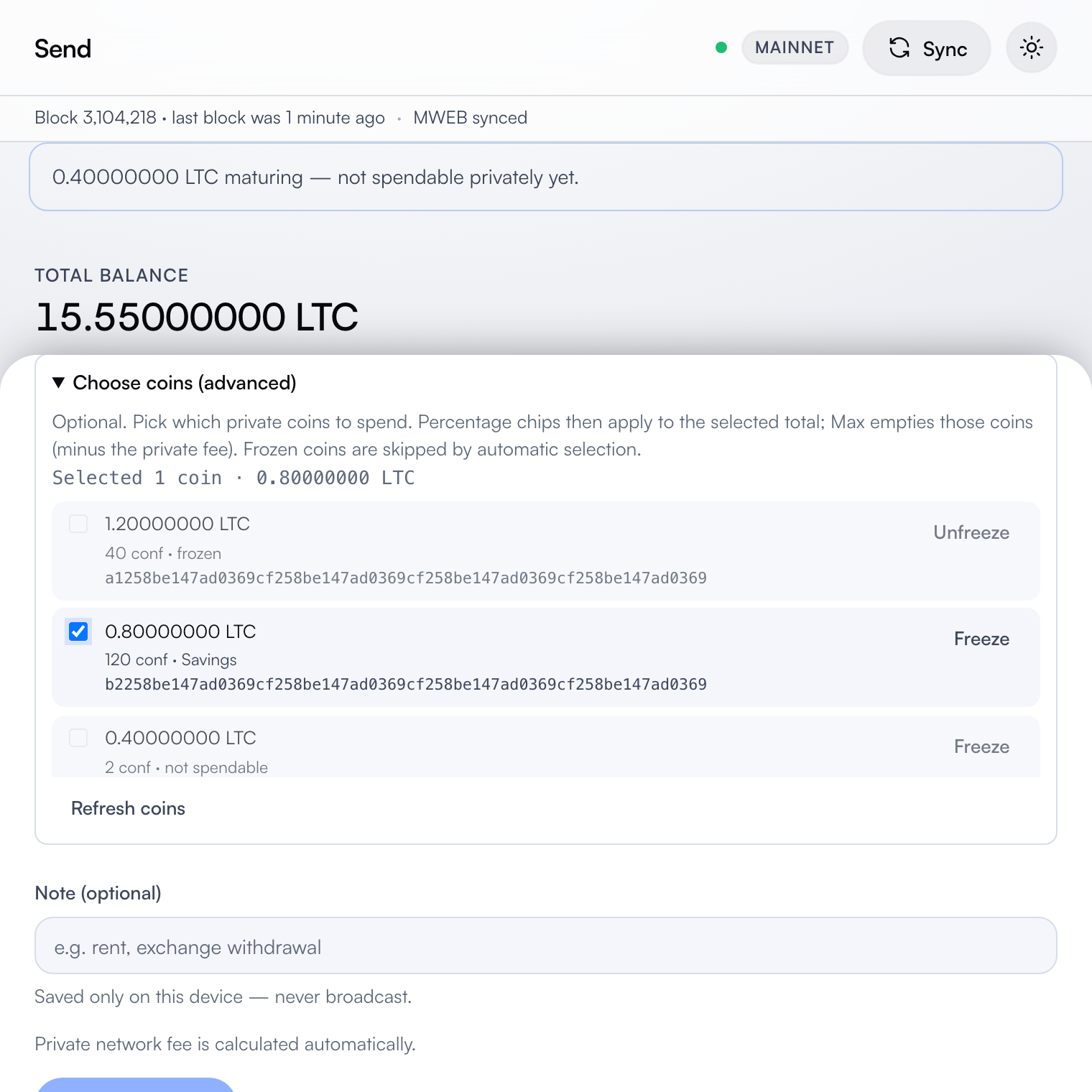
Why the coins are on screen
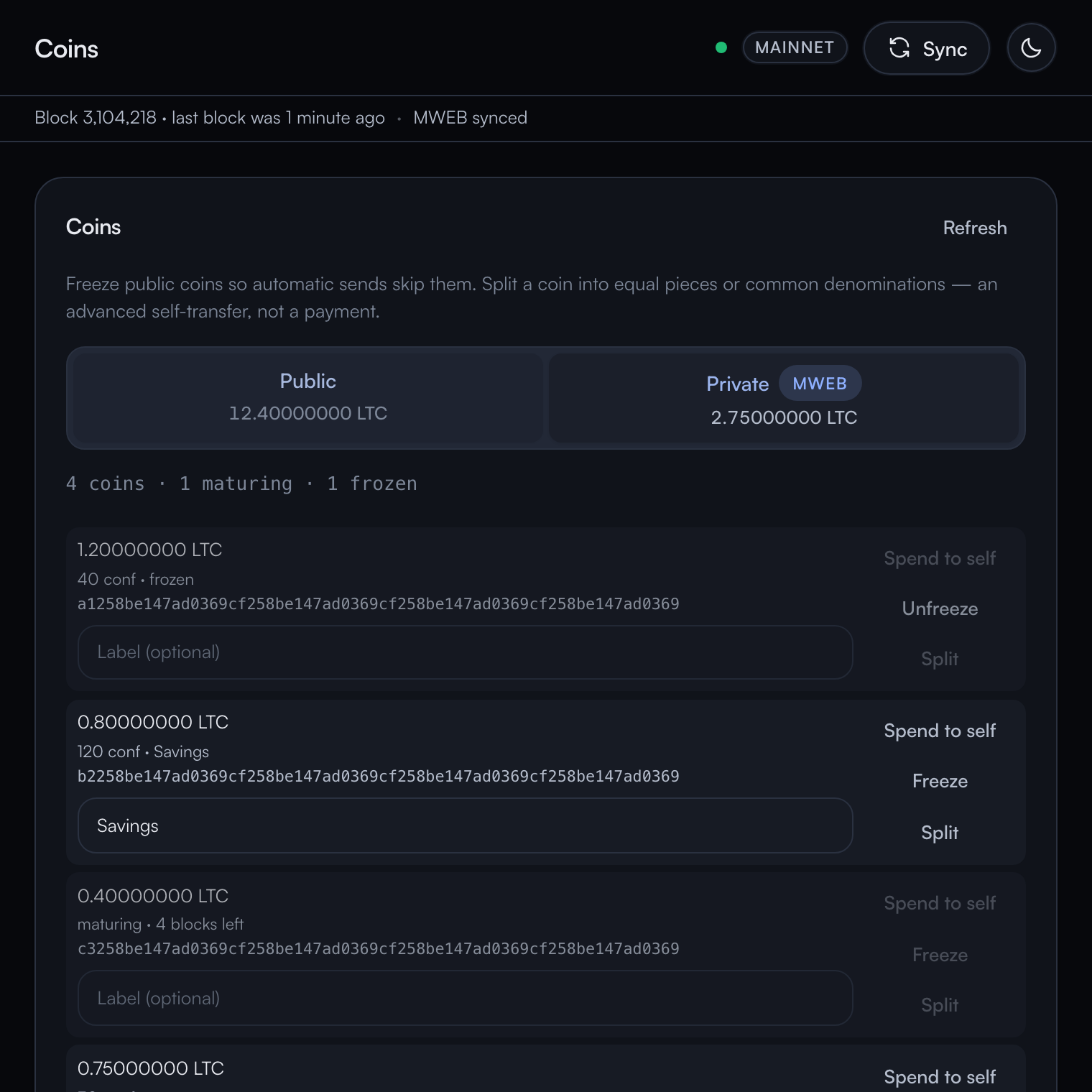
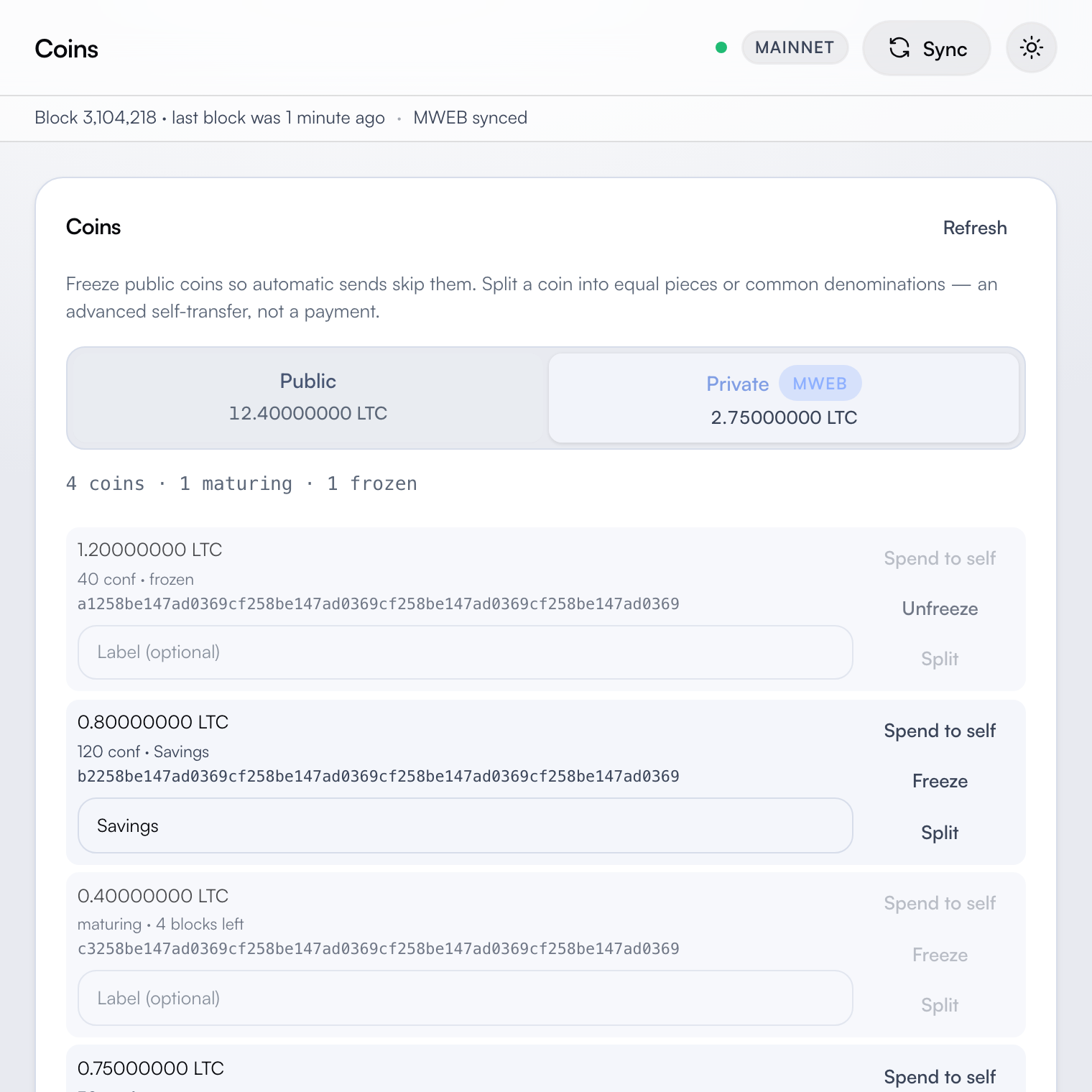
The Coins list is the shared surface for this. Transparent and Privacy coins can be listed, frozen, labeled, and split. Send, peg-in, and peg-out then accept that selection instead of inventing one. The result is that Privacy is something you can inspect coin by coin: which output is frozen, which one you labeled, which one is maturing, and which ones will move.
The desktop wallet that implements this is the v0.4.13 prototype. It has not been independently audited. Coin control makes the coins visible and selectable. It does not, by itself, change what a peg-in, a Privacy spend, or a peg-out reveals on chain.