Transparent coins sync through an Electrum server. Privacy coins sync through LIP-0006 peers. Both are chosen in Settings. Price, fee hints, and Insights use a different host, described in Status and Insights.
Connection
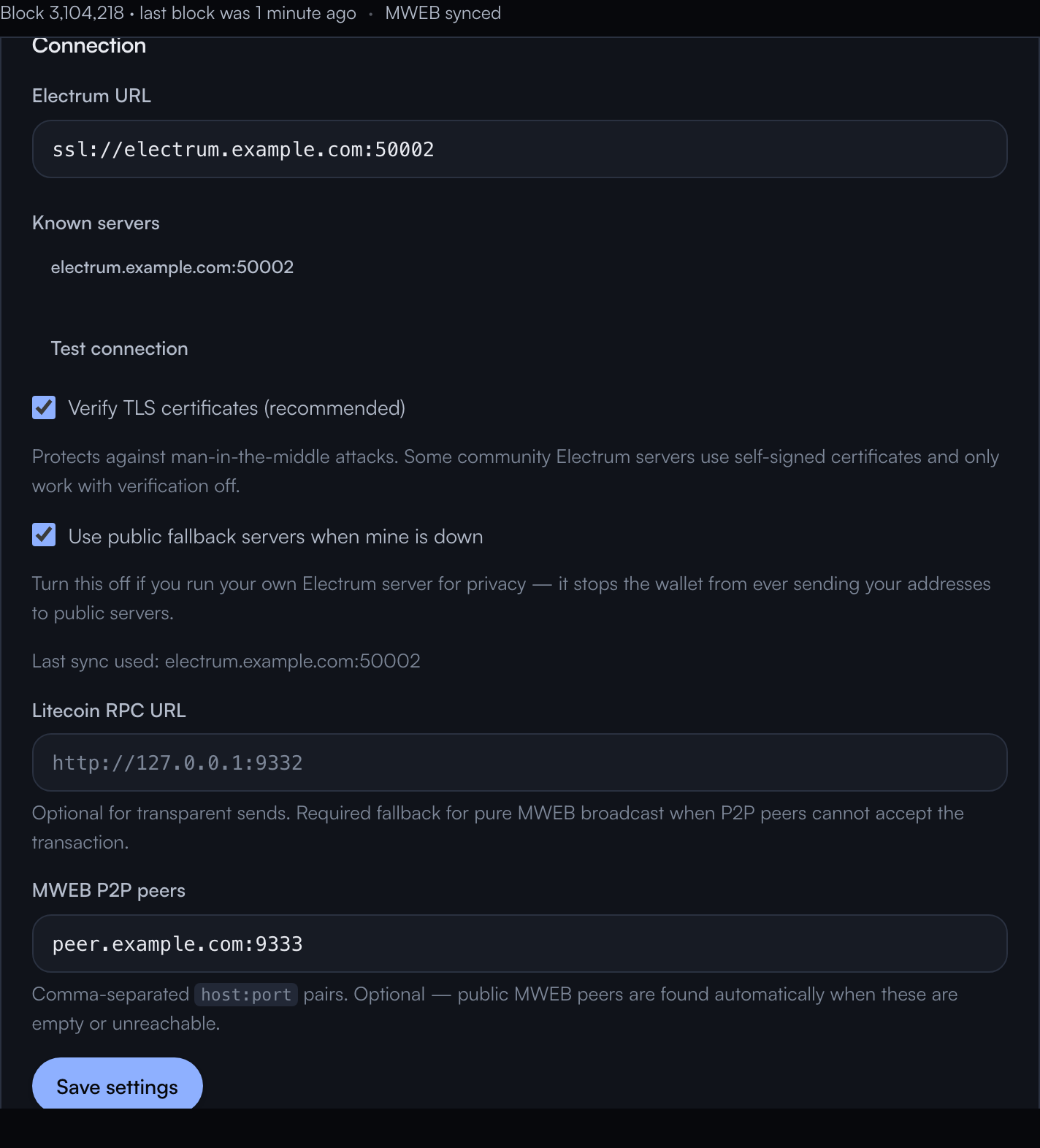
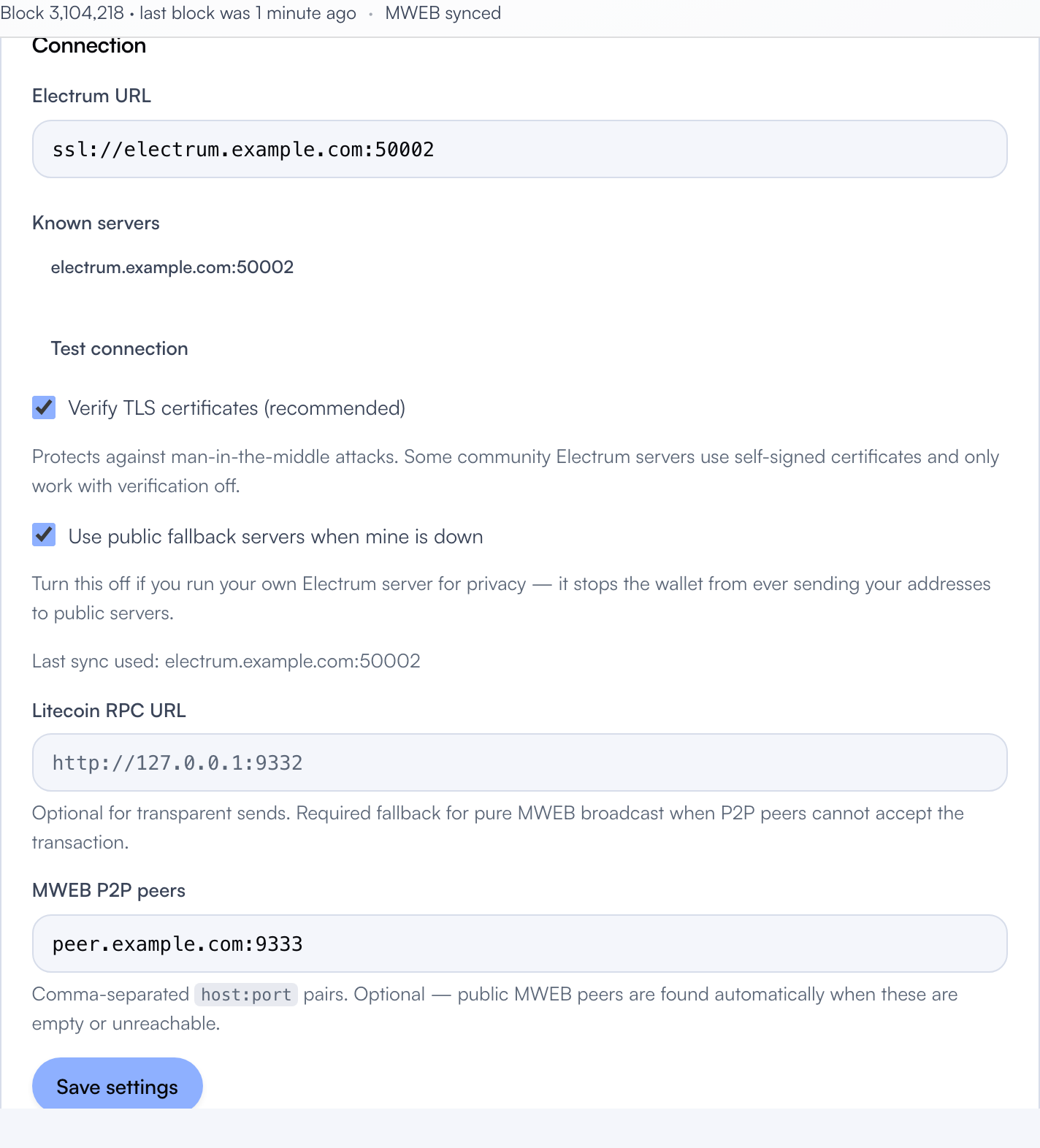
The card is titled “Connection.” The Electrum URL is the server the wallet tries first. A new mainnet wallet starts at ssl://electrum1.cipig.net:20063. Known servers lists the built-in fallbacks. Test connection reports the tip height, the round trip, and the host that answered. After a sync, the same card names the server that sync used.
TLS certificate verification is on. The cipig.net servers present CA-signed certificates and work with that check. Some community servers use self-signed certificates and connect only when verification is off. A tcp:// URL is called out on screen, because that path can read addresses and responses.
“Use public fallback servers when mine is down” tries the known servers after the URL you set. Turn it off when the URL is your own Electrum server, so transparent addresses stay on that server.
Litecoin RPC is optional for a transparent send. It is also the fallback for a pure MWEB broadcast when P2P peers cannot accept the transaction. It is required for Privacy self-spend: the wallet watches the MWEB mempool through that node, and without a working URL “Spend to self” is unavailable. The placeholder for a stock local node is http://127.0.0.1:9332.
MWEB P2P peers are optional host:port pairs, separated by commas. When the field is empty, or those peers are unreachable, the wallet looks up Litecoin DNS seeds and keeps peers that complete a handshake advertising MWEB light-client support. That pool is cached for fifteen minutes.
What those servers learn
Settings includes a panel titled “What leaves this computer.”
- Electrum learns your transparent addresses and your IP.
- MWEB peers learn your IP.
- Litecoin RPC, when configured, learns your IP and sees the MWEB mempool queries and broadcasts the wallet sends through that node.
- The explorer learns your IP for price, fee hints, and Insights, and learns a transaction id when you open one. Address lists stay on this computer. That split is the Status and Insights note.
- LitVM RPC learns your IP and the LitVM
0xaddress when that tab is open or a zkLTC send is made. - The transparent wallet database on disk is plaintext. Full-disk encryption is what protects that file.
There is no Tor or proxy setting. Turning off Insights, the fiat price, and fee-rate suggestions limits explorer contact to pages you open yourself.
MWEB data
A second card can rebuild the local Privacy database from the chain. Changing the MWEB derivation scheme does that rescan on the new branch. Transparent funds stay on their existing addresses. The same two choices appear on restore. Litecoin Core / LIP-0004 is the default, and LIP-0004 follows Core at m/0'/100'/{0,1}'. Nexus since 1 June 2026 uses that path. “mwebd (before 1 June 2026)” is the older m/1000'/2'/0'/{0,1}' layout.
Connection ships in the v0.4.13 prototype. Like the rest of this wallet, it has not been independently audited.