The desktop wallet keeps two different pictures of “where the chain is.” One is the wallet’s own sync: Transparent coins through Electrum, Privacy coins through LIP-0006. The other is a small status strip, plus optional price and Insights from litview.space. The second picture is allowed to move while a full sync is still running, or while you have not asked for one.
How old the tip is
The status strip is persistent. When the wallet knows a tip height, the strip shows that block. When it also has a header time that belongs to the same height, it adds the age in words: the last block was just now, or a count of minutes, hours, or days. The age text keeps its own clock. It does not wait for the next full wallet sync before the sentence changes.
The block control is a button. Activating it opens that block in the explorer. If Electrum is in error, the strip shows the error and the button is disabled, so a stale height is not offered as a link. Before the first successful sync, the strip says the wallet is not synced.
Next to the height, a short Privacy label shares the strip. The longer Privacy account stays on the Privacy card. The short label covers the states you need at a glance: idle, not synced, stale, synced when the Privacy height matches the tip, or the height Privacy has actually reached. If the status text is an error, the strip keeps the first clause and drops the trailing leafset detail.
Price and Insights refresh on their own
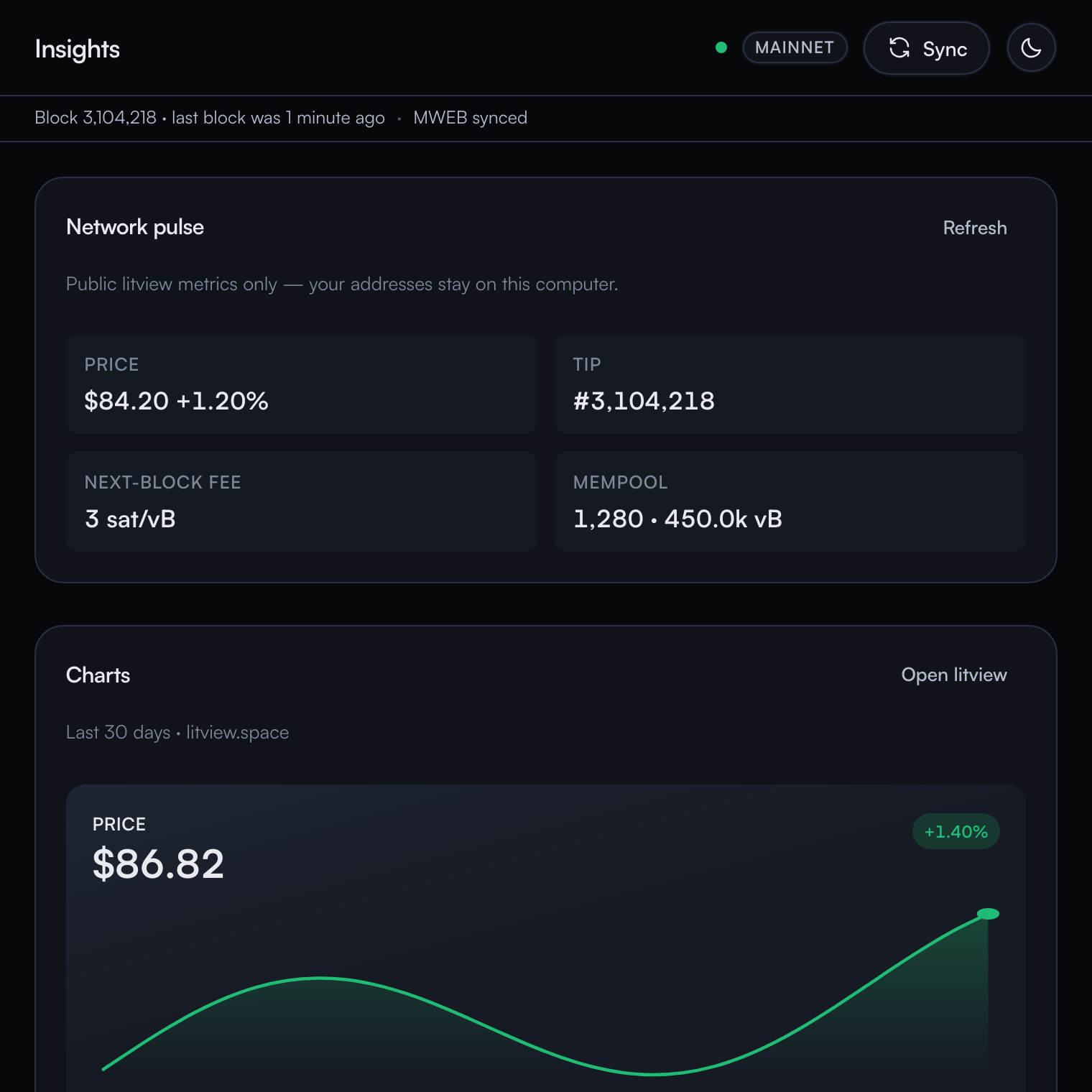
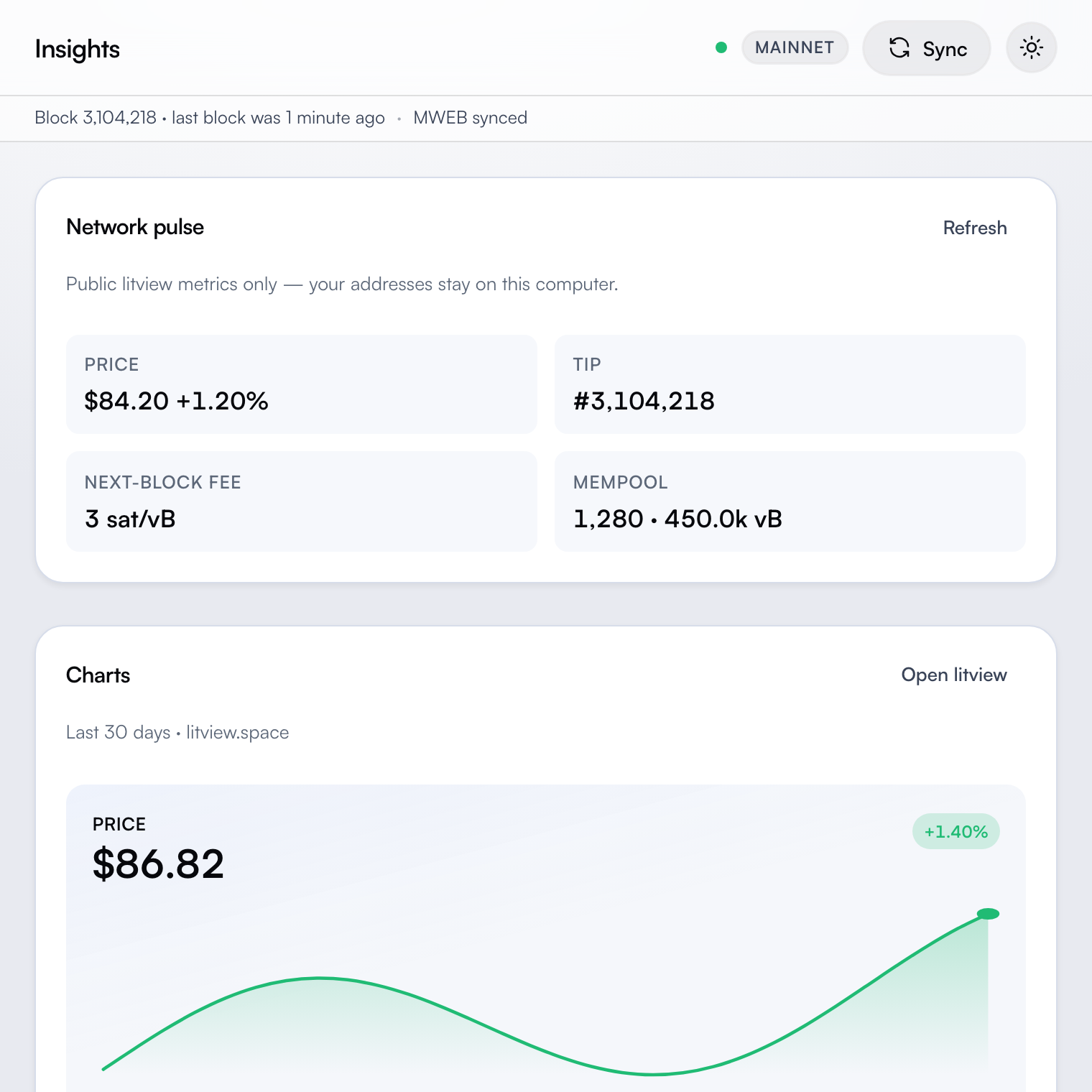
litview is a remote chain index and explorer. The wallet does not embed the indexer, and it does not load the litview site inside its window. The interface calls into Rust. Rust performs the HTTPS requests with ureq. A “view on litview” link opens in the system browser. The window’s content security policy stays limited to the wallet’s own calls.
Price and Insights are not a side effect of syncing the wallet. Spot price refreshes on its own while the wallet is unlocked, about once a minute. That request learns an IP address and nothing about your coins, and Settings can turn it off. The Insights pulse — tip, price, fees, and mempool — refreshes about every ninety seconds while Insights is enabled. Charts load when the Insights view is open or when you refresh it, from an allowlist of daily series. Fee chips on the send form come from the same explorer. They are suggestions, not a fee the wallet invents, and they can be switched off in favor of a local estimate.
Settings remember the explorer base URL (litview by default), whether to show a fiat price, whether to use explorer fee hints, and whether Insights is on. Older wallets pick up those defaults when the fields were never stored.
Wallet addresses are not uploaded. Nothing in this integration scans an address or an extended public key against litview. The privacy boundary is narrower than “the explorer sees your wallet,” and it is specific:
- Opening a transaction in the browser sends your IP and that transaction id, because you opened the page.
- Opening transaction detail can request enrichment for that one id. If the response includes inputs and outputs, the wallet marks which of them are yours locally, by matching scripts it already knows. It does not send the address list in order to find out.
- Price, the fee ladder, the Insights pulse, and the charts send an IP and no address set.
The wallet does not ask litview for address history. It does not embed Litecoin Core. It does not port the litview explorer into the app, and it does not add a news feed or any other remote content beside the calls above.
History, with amounts in lits
History can be searched and filtered, and it can be exported as CSV or JSON through a save dialog. The file is a history export, not a backup of the seed. Amount columns are labeled in lits: net, sent, received, and fee (net_lits, sent_lits, received_lits, fee_lits). Each row also carries the transaction id, a kind slug, height, confirmations, timestamp, and the note from that transaction’s label when one exists.
The on-screen unit can be LTC or litoshis. The export keeps integer lit columns so a spreadsheet is not parsing a decimal string you happened to be looking at. Kinds include the wallet’s own names for Transparent activity, peg-in, peg-out, Privacy send and receive, splits, and self-spend (mweb-churn in the file).
Insights, the status strip, and history export are part of the v0.4.13 prototype. They have not been independently audited. Turning Insights on does not upload the wallet. It does contact litview from your network, on the schedule above, for the public chain data those screens show.